Disability in Ancient Greece: Myths, Facts, and Accessibility...
Professor Debby Sneed explores disability in...

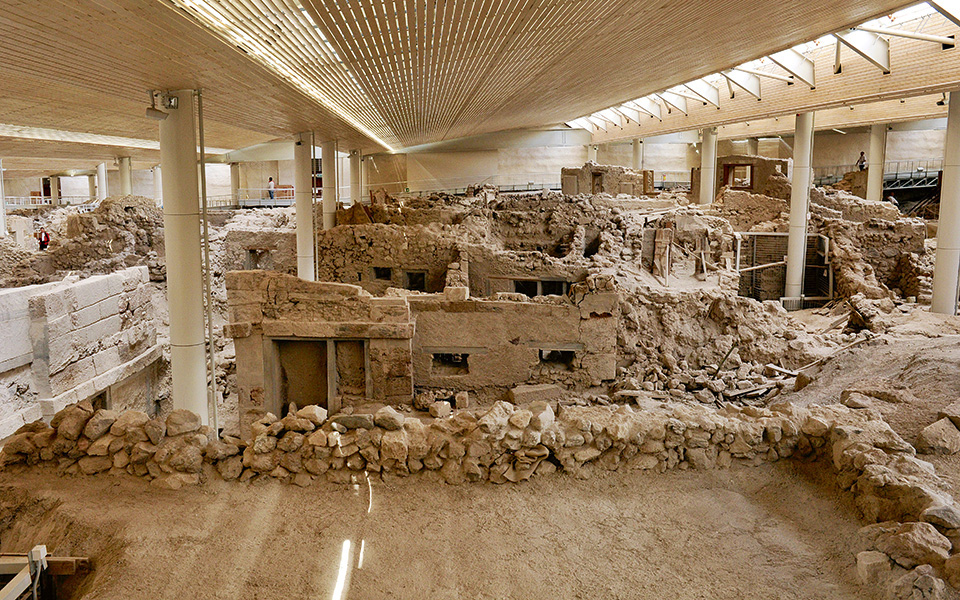
Excavations have brought to light a settlement with a sophisticated layout.
© Vangelis Zavos
Akrotiri was a settlement with stone-paved streets and squares, a prudently designed zoning plan and an advanced sewage system. The houses were two- and three-story, built with stone and mud. The ground floors housed craftsmen’s workshops and storerooms, mainly for food. The rooms of the upper stories were bathed in natural light streaming in through large windows. Most walls were decorated with elaborate paintings depicting people, animals and plants. The furniture was wooden and the loom was an essential household item, used by the lady of the house to weave the family’s clothes. The inhabitants were traders, artisans, mariners, farmers, stock breeders and craftsmen. They kept flocks of sheep and goats. They planted wheat and barley, which they harvested with stone or bronze sickles. They stored produce in large earthenware jars and cultivated olives, from which they made oil. Indeed, output was so high that they also exported. Wine production was another key economic activity. Locals further supplemented their income by supplying Crete with large quantities of obsidian (black volcanic rock) and metals. Their diet consisted of pulses, vegetables and all sorts of fish, caught in the surrounding waters and sold in the harbor. But their favorite delicacy was snails, brought to the island from Crete.
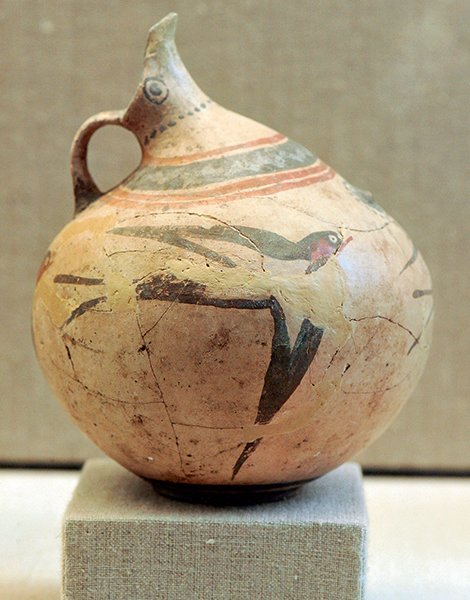
Jug decorated with swallows, a favorite motif of Theran potters. (Museum of Prehistoric Thera, Fira)
© Vangelis Zavos
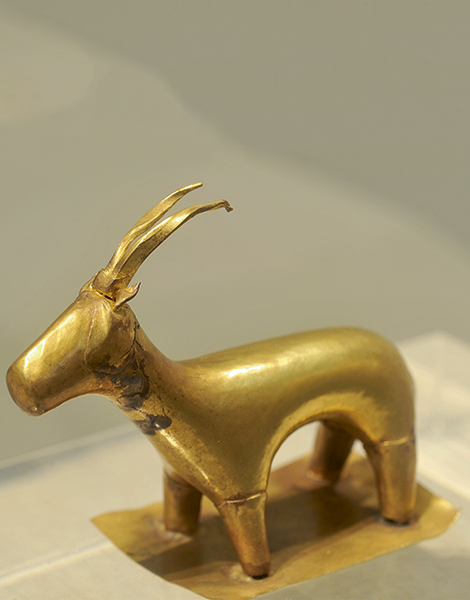
Gold ibex figurine, 17th century BC. Very few precious artifacts have been found at Akrotiri, since the inhabitants probably took their valuables with them when they left the island. (Museum of Prehistoric Thera, Fira)
© Vangelis Zavos
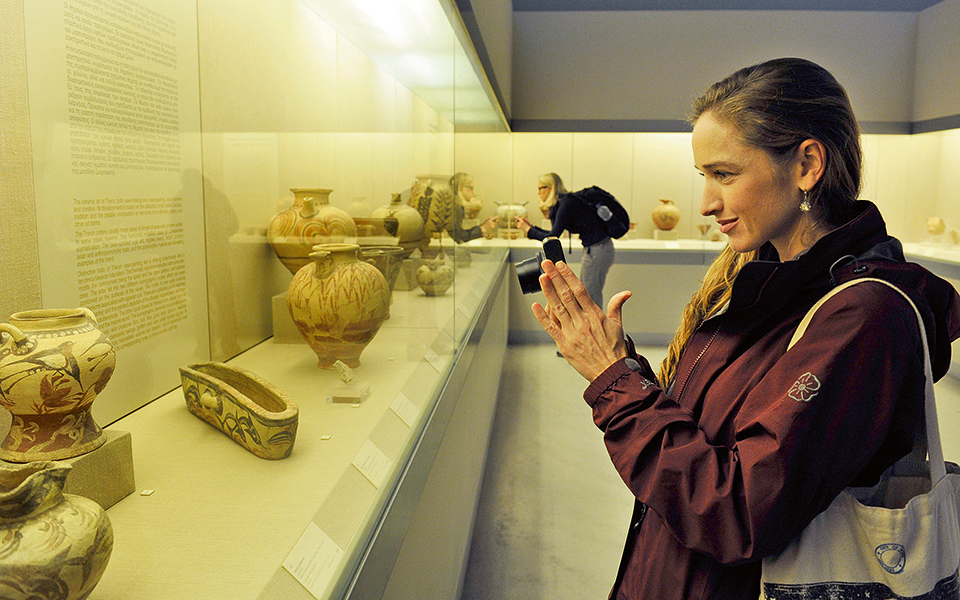
Visitors to the Museum of Prehistoric Thera never cease to be amazed by the masterpieces of prehistoric ceramic work.
© Vangelis Zavos
“ Men, women and children are equally depicted in wall paintings. For this reason, Akrotiri is also called the Prehistoric Venice of the Aegean. ”
This is how Christos Doumas, emeritus professor of archaeology at the University of Athens, describes life in Akrotiri during the 2nd millennium BC. He also speaks about the wealth accumulated on Thera in that distant time from commerce: “The island had trade relations not only with Crete but also with mainland Greece, the Dodecanese, Cyprus, Syria and Egypt.” Thus, the prehistoric Therans, having satisfied their basic needs and thanks to the wealth they gradually acquired, were able to turn their attention to more pleasurable pursuits, for instance the art of good eating. Doumas focuses in particular on how art flourished as a means of projecting social status, and on the democratic structure of Theran society. “It is telling that men, women and children are equally depicted in wall paintings. For this reason, Akrotiri is also called the ‘prehistoric Venice of the Aegean’.”
This then was the situation until the spring of 1613 BC, when the island’s volcano came out of its slumber. The eruption that followed, the most powerful in the world of the past 10,000 years, completely destroyed Santorini (Thera) and the nearby islands. “If there had been no volcano, however, there would have been no Santorini as we know it today and, of course, there would have been no Akrotiri. Thanks to the volcanic ash, the remains of the prehistoric settlement have been preserved down the centuries,” explains the man who has made this place his life’s work.
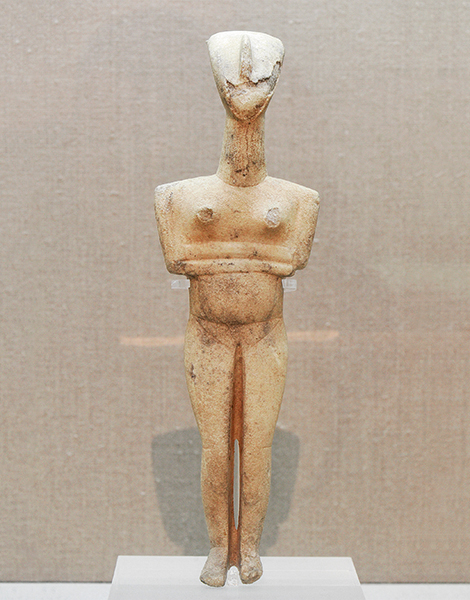
Early Cycladic marble figurine. (Museum of Prehistoric Thera, Fira)
© Vangelis Zavos
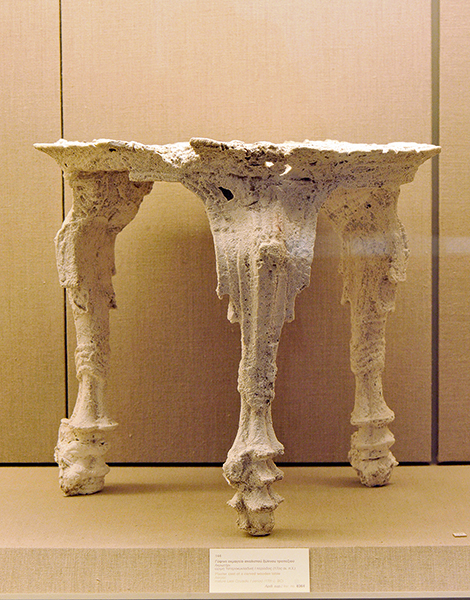
Plaster cast of a carved wooden table, 17th century BC. (Museum of Prehistoric Thera, Fira)
© Vangelis Zavos
“ The prehistoric Therans, having satisfied their basic needs and thanks to the wealth they gradually acquired, were able to turn their attention to more pleasurable pursuits, for instance the art of good eating. ”
In 1975 Doumas took over the excavations begun by the eminent archaeologist Spyridon Marinatos. Since then, he has brought to light an incredible wealth of information about the “Pompeii of the Aegean.” And at the age of 82 he continues to work ceaselessly. “We should be proud of Akrotiri,” says Doumas. “It is part of archaeology courses at universities all over the world. In the history of Aegean civilization, it is considered to have equal importance with the Acropolis (for the Classical period) and Mount Athos (for the Byzantine period). It is a momentous legacy.” All this makes a visit to Akrotiri a unique experience. The archaeological site (covering an area of 12,000 m2) is protected by a bioclimatic shelter that is supported by 96 steel columns, designed by the architect Nikos Fintikakis. Specially designed walkways take visitors around and through the settlement, while there are viewing platforms that provide excellent vantage points.
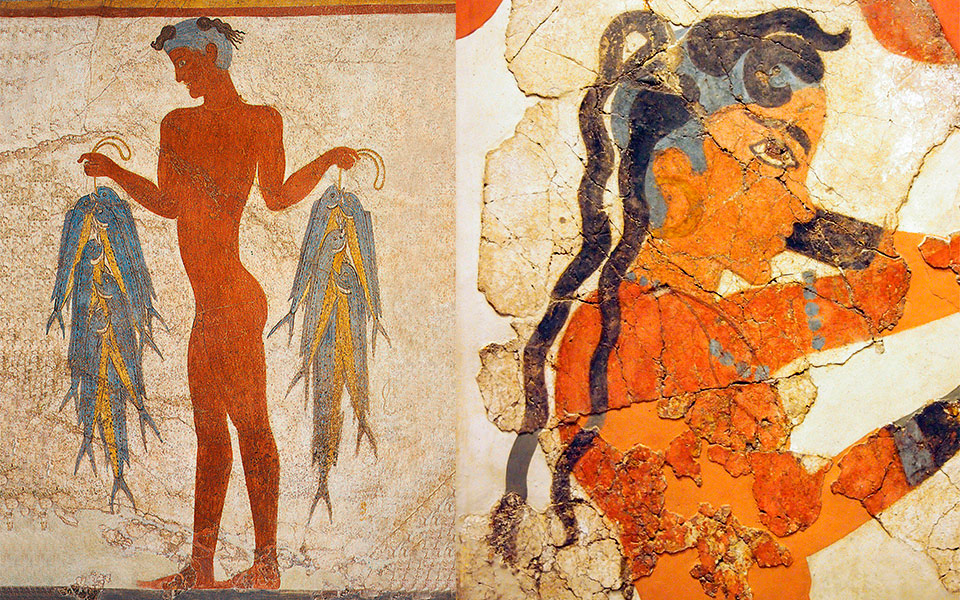
(L) One of the two Fisherman frescoes, found in excellent condition. Experts believe the two nude youths depicted in the paintings were making an offering as they are shown walking toward the spot where archaeologists found an offering table. (Museum of Prehistoric Thera, Fira) • (R) Detail from the Boxers, one of the most famous wall paintings from Akrotiri. The boy seen here is wearing large amounts of jewelry, as opposed to his sparring partner, who has none. The scene depicts a playful display of strength rather than competitive sport. (National Archaeological Museum, Athens)
© Vangelis Zavos
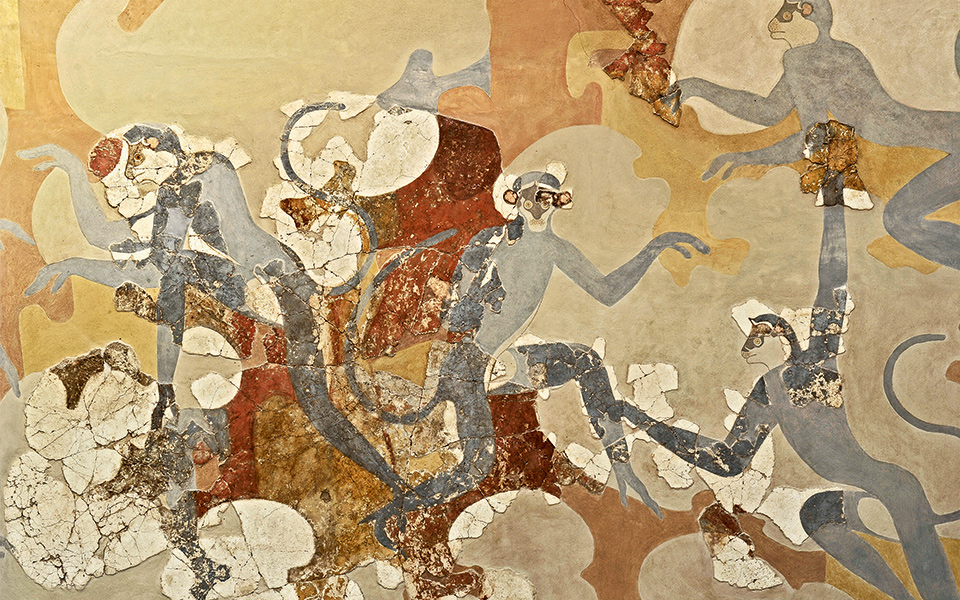
Detail of the Blue Monkeys fresco, 17th century BC. An exquisite piece showing monkeys scrambling up a rock to escape a dog, with a realism that suggests the artist had actually seen the animal even though it was not endemic to the island. (Museum of Prehistoric Thera, Fira)
© Vangelis Zavos
And, of course, at the Museum of Prehistoric Thera in Fira, the experience is enhanced with important finds from the excavations: marble figurines, pottery, bronze implements, cooking utensils and impressive storage jars with designs indicative of their content. Pay close attention to the celebrated Theran wall paintings (Blue Monkeys fresco, House of the Ladies fresco, etc), the work of outstanding artists, as well as artifacts (seals, lead weights, clay tablets inscribed with Linear A script) that provide evidence that the complex society of prehistoric Akrotiri devised and used systems of writing and measurement. That is, they applied methods for the management of goods, developing a type of bureaucracy. Finally, just before leaving the exhibition area, don’t forget to visit the most impressive find: a gold ibex figurine, quite unique, which was found in December 1999 in excellent condition in its wooden case. Concluding our conversation with Professor Doumas, I ask him what Akrotiri means to him personally. “The scene of the… crime,” he replies laughing. “I will always return here, as long as I can still stand. And when you consider that only 3 percent of the prehistoric settlement has been investigated, we archaeologists still have many centuries of work beneath the shelter!”
“ A civilisation is determined by man’s response to the environment. Santorini does not exist without the volcano; it is its child. The volcano created the island, as well as the conditions under which the people live. All of its quirk, its landscaped, crops and wines, are the product of the volcano. ”
AKROTIRI lies at the south-western tip of the island, 15 km from Fira • The ARCHAEOLOGICAL SITE is open 8 a.m. – 8 p.m., daily (until the end of October) • Tel. (+30) 22860.81.939 • MUSEUM OF PREHISTORIC THERA: Fira • Tel. (+30) 22860.23.217, Open daily except Mondays (8 a.m. – 3 p.m.) • DON’T FORGET to buy original souvenirs and objects of art from the newly installed wooden kiosk of the non-profit Society for the Promotion of Studies on Prehistoric Thera, just outside the complex. All proceeds go toward the excavation and restoration work in Akrotiri.
Professor Debby Sneed explores disability in...
Beneath the busy streets of modern...

From Santorini sunsets to ancient ruins,...

A once-mighty city-state overlooking Souda Bay,...